


SIDE QUEST / AUSTRALIA / ROAD TRIP
THE LONG WAY TO ULURU
8 KM OF FUEL. A TINY HATCHBACK. A VERY BIG COUNTRY.
Somewhere on a dirt road in the middle of nowhere, with the dashboard telling me I had about eight kilometres of fuel left in the tank, I started doing the kind of maths you never think you'll actually need in real life — how far can a man walk out here, how long before someone finds him, how do people actually end up as one of those stories about the Outback. It wasn't dramatic panic. It was quieter than that, and worse, because I already knew exactly whose fault it was going to be.
SO LET ME BACK UP TO WHERE IT ACTUALLY STARTED.
It was 2020, a couple of months after Queensland had begun lifting its COVID restrictions, and I was thirty-one years old, living in a big place on the canals in Bundall. My relationship of about three years had recently ended, and the overseas trip I actually wanted to take wasn't an option because the airports still weren't properly open for that kind of travel.
After months of being stuck in one place, I had that itch you get when you've been sitting still too long and your body starts wanting to move whether you've got a plan or not. So I opened Google Maps one afternoon, typed in Gold Coast to Uluru, and it told me the drive was roughly thirty-three hours. That didn't sound like much to me at all. I'd driven Cairns to Brisbane before. I'd driven Melbourne to Brisbane.
Long hauls on the highway had never really bothered me, and it didn't occur to me that driving a long way down a major road and driving into the actual guts of inland Australia were two completely different exercises. The idea landed in my head early in the week, and by the end of it I was already gone.


I packed the way you'd expect from someone who'd given himself two or three days to plan a trip like that. A small two-man tent. An Esky. Jerry cans. About a week's worth of clothes, some blankets, a camping stretcher, two pillows, a chair, a light, a bit of weed, and a scattering of other things I decided at the last minute I'd probably need. I had no cooking equipment whatsoever. I told work I wanted two weeks off to drive to Uluru, and when they asked who I was going with, I told them myself, and they looked at me like I'd just announced I was going to walk there instead.
My first stop was Dad's farm, a couple of hours out, to grab another jerry can before I properly left civilisation behind. Dad thought the whole idea of taking my little 2007 Ford Fiesta through the Outback was ridiculous, and standing there next to the car while I loaded the last of my gear, he crouched down and noticed something he liked even less than the plan itself — one of the front tyres had worn down so far you could see the steel wire showing through the rubber. He told me I needed to get it replaced before I went any further.
Then he told me something else: part of the road I was planning to take wasn't sealed. I'd been told the whole route was sealed the entire way, so I decided his information must have been out of date, that maybe the road had been paved more recently than he realised. Either way, I was going. I never replaced the tyre. I want that on the record now, because somehow — and I still don't understand how — that tyre survived the entire trip, steel wire and all.
I FILLED THE CAR. I DID NOT FILL THE JERRY CANS.
The sun was starting to go down by the time I pulled into a servo to fill up properly before pushing further inland. I filled the car. I did not fill the jerry cans, mostly because I hadn't transferred any money into the account attached to the card I was trying to use, and the servo happened to be sitting in a dead spot with no reception at all. I spent close to twenty-five minutes standing at the counter having a quiet meltdown before the bloke working there let me use his own connection to sort my banking out. Eventually I got back in the car and kept driving inland as the light disappeared.
I drove most of that first night with the windows down and the music turned up too loud, singing along to whatever came on — rock, driving anthems, a bit of Aussie hip hop, the kind of unsorted playlist that only makes sense to the person driving. I kept pulling over for photos as the landscape opened up bigger and emptier with every hour, the sky doing things out over those flat horizons that you just don't see back on the coast.
At some point the Fiesta's air-conditioning gave up without telling me, and because it was brutally hot through the day, I ended up driving with my feet half hanging out the window trying to catch whatever breeze I could find. It wasn't smart. It worked well enough that I kept doing it anyway, kilometre after kilometre, until it just became part of how I drove.


I came through Boulia late that night with everything shut, and just outside town I spotted a sign pointing toward the Northern Territory. I turned onto it, assuming there'd be fuel somewhere between there and the border. Then something in my head finally made a sensible call, and instead of pushing on tired, I pulled over near the sign and slept a few hours curled up in the back of the Fiesta, seats folded down, knees somewhere near my chest. In the morning I drove back into Boulia for breakfast and found fuel there. I filled the car. I did not fill the jerry cans. Again.
THEN DAD TURNED OUT TO BE RIGHT.
Not far past Boulia, Dad turned out to be right about the road. The sealed bitumen simply ended, and the road became rough red dirt, corrugated and dusty, with long stretches where I might see one vehicle an hour, usually a road train thundering past and leaving the Fiesta coated in a fresh layer of dust. There was no phone reception out there at all, and the country around me felt properly remote in a way nothing on the trip so far had.
That was when the fuel gauge started dropping in the way that makes your stomach drop right along with it. I watched it fall past the halfway mark, then further, doing rough sums in my head about how far I actually was from anywhere with a bowser. Eventually I saw a sign pointing toward a small town about twenty kilometres off the main road, and I sat there working out the maths properly — twenty kilometres in, twenty kilometres back out, and if the place had nothing, I'd be rejoining the main road with maybe forty kilometres of range left and absolutely no idea how far the next fuel stop actually was.
There was no way to check. I decided to gamble on the town anyway, because at that point turning back didn't feel any safer than pushing on.

There was no petrol there.
8 KM
That's when I properly started to panic. I remembered Dad telling me to fill the jerry cans before I left. I remembered not doing it, and then not doing it again the next morning in Boulia. I got back onto the main road and kept driving, watching the estimated range keep dropping — lower, then lower again — until the dashboard was reading somewhere around eight kilometres remaining. No reception, almost no fuel left, and no idea when another vehicle might come past — I kept working out what I'd actually do if the car stopped right there, in the middle of absolutely nothing.
Then I saw it. A tiny, hand-painted sign, nothing more than one word and an arrow: FUEL.
I followed the track it pointed down toward an old farmhouse, an ancient-looking petrol pump standing out the front of it like something from another decade entirely. I pulled up, and a screen door banged somewhere behind the house. A woman came out, looked at this filthy little Ford Fiesta that had clearly come a long way it had no business coming, and asked me straight out, "What the hell are you doing out here in that thing?"
I told her someone had told me the road was sealed the whole way. She laughed properly at that, shaking her head, and said, "They got you good, didn't they?" She hand-pumped the fuel into the tank herself, working an old lever mechanism instead of anything digital, and charged me almost double what I'd have paid back on the coast. I didn't care in the slightest. Ten minutes earlier I'd been sitting in the driver's seat mentally rehearsing my own cautionary tale, and now I was watching a woman in the middle of nowhere save the entire trip with a machine that looked older than I was. She seemed genuinely impressed that both me and the car had made it that far in the first place.
OF FUEL LEFT.
NO RECEPTION. NO FUEL. AND TWO PERFECTLY GOOD EMPTY JERRY CANS.

AND THEN THERE IT ACTUALLY WAS.
From there I pushed on toward Alice Springs, arriving exhausted in a way that had less to do with tiredness and more to do with everything the day had put me through. I'd already decided to camp for several nights once I reached Uluru, so I gave myself one proper night in a hotel there — a shower, a wander around, dinner somewhere, and an early night without venturing too far after dark, given the town's reputation.
The next morning I got up early for the final four-hour stretch toward Uluru, reached Yulara, found the campground, and set up my sad little two-man tent with a stretcher, two pillows and one blanket that would turn out to be nowhere near warm enough for what the desert nights actually had in store.
The drive in toward Uluru does this thing where every distant shape on the horizon starts to look like it might be the rock, and every time it isn't, until eventually it actually is, and it's bigger than anything the photographs had prepared me for.
I remember driving toward it with an enormous, stupid grin on my face. I'd seen it in photos my whole life, but actually being there in front of it was completely different — way bigger than I'd pictured, and it properly took my breath away. I spent the day walking the base, close to three hours out there with no shirt on, wearing one of those fly nets over my head because the flies refused to leave me alone for a second, getting steadily more sunburnt and steadily happier as the hours went on.
Being that close to it changed everything about the scale of the place. From a distance it's a shape on the horizon. Up close it's enormous in a way that's hard to properly explain unless you've stood right underneath it.


THEN I SMOKED AN ENORMOUS JOINT.
That evening I showered, grabbed dinner from the campground canteen, and got ready for a trip I'd booked out to Field of Light, the illuminated art installation set up in the desert nearby. With some time to kill before the bus, I smoked a genuinely enormous joint, which turned out to be a significant miscalculation in terms of time management. I got extremely high, lost track of things completely, and then suddenly realised with a jolt that the bus was about to leave without me.
What followed was a full sprint through the campground in the dark, shirt half done up, bag hanging open with things threatening to spill out with every stride, trying simultaneously to dress myself properly, keep my belongings inside the bag, and locate the actual bus. I made it on board at the absolute last possible moment, the very last person to get on, and every single other passenger was already sitting there calm and settled in their seats when this dishevelled, half-dressed, extremely stoned idiot stumbled up the steps. I tried, unconvincingly, to act like a functioning adult for the rest of the ride.
Once we actually arrived, though, being that high turned into one of the better decisions I made on the whole trip. The lights stretched out across the desert in enormous glowing fields, thousands of illuminated stems slowly shifting through colour, like some huge sea of tulips out there in the middle of the desert, dark silhouettes of other visitors moving quietly between the pathways in the distance. I found a bench at one point and just sat there, completely disappearing into it for a long while, not really thinking about anything else at all.
I WASN'T LONELY OUT THERE. I FELT FREE.

The following day I went out to Kata Tjuta, the Olgas, and did another hike of around three hours, walking in among those strange, enormous domed formations. It was hot again, and I was burning again, and I was having, again, an absolutely brilliant time. I wasn't spending much time talking to other travellers out there, and I wasn't particularly lonely either — I didn't care much either way. I was out there doing the thing I'd come to do.
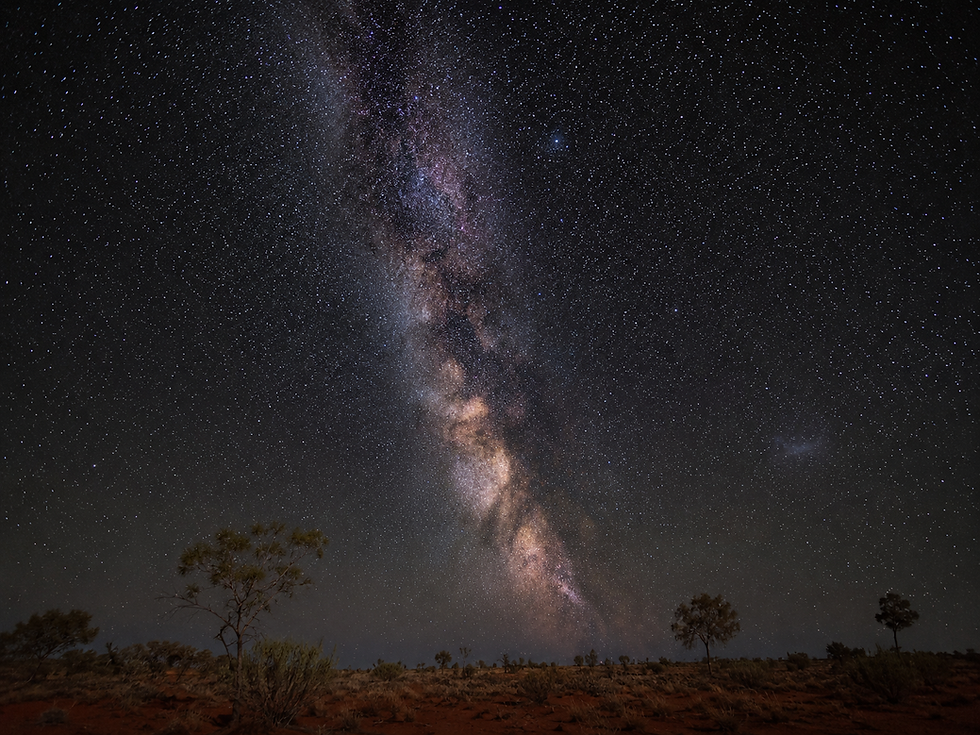
It was the nights that I remember most clearly, though, even alongside the two big hikes. Away from any city light pollution, the sky out there was ridiculous, properly stacked with stars, the Milky Way visible in a way I'd never actually seen it before. Most evenings I'd sit outside the tent for a couple of hours, smoke a bit, and just stare upward looking for shooting stars while the temperature dropped hard around me and that one useless blanket did almost nothing to help. During the day I'd been walking through some of the most famous landscapes in the country. At night I was freezing outside a tiny tent, stoned, staring into space, and somehow completely content with exactly where I was.
I still missed my ex. Driving thousands of kilometres into the desert hadn't made that disappear, and I don't think I expected it to. But I wasn't lonely out there. I felt free. If you'd asked thirty-one-year-old me, sitting in the dirt at midnight, why he was out there instead of at home, the answer would have been simple and immediate — adventure — and I would have meant it completely, without thinking any further than that.
GETTING THERE WAS ONLY HALF THE STORY.
COOBER PEDY & THE LONG WAY HOME
Because the dirt road coming in had rattled me enough, and because I was starting to develop at least a small concern for the wellbeing of the Fiesta, I decided against retracing that same unsealed stretch on the way home. Instead I chose the longer, fully sealed route south through Coober Pedy and Adelaide, then back up through New South Wales toward Queensland, which turned the return trip into its own separate adventure entirely.
Driving into Coober Pedy, I remember just thinking, what in the hell is this place. Houses and businesses were carved straight into the hillsides, and as I wandered around I kept coming across odd sculptures dumped along the roadside — spacecraft-looking things, old rusted machinery left exactly where it had stopped working, the whole place feeling more like a film set than an actual town.
Out past the edge of town the ground opened into pale salt flats stretching further than made any sense, and at one point I drove past a stretch of the Dingo Fence running off toward the horizon. I ended up staying one night in an underground motel, which felt exactly as strange as it sounds, and spent most of my time there just walking around slowly, taking it all in. It didn't feel like a tourist stop. It felt like somewhere genuinely strange, unlike anywhere else on the trip.
Adelaide got one quiet night on the way through, nothing especially eventful, mostly just a stopover to break up the long stretch south before I turned back east toward home.


THE FIESTA WAITED UNTIL ALMOST HOME TO DIE.
Somewhere through northern New South Wales I came across a stretch of road with what felt like thousands of wild baby goats scattered along both sides, jumping and skittering around after weeks of desert and empty highway. It was such a random, unexpected thing to see that I still think about it now — no lead-up, no explanation, just goats everywhere for a good stretch of road, and then gone again.
As I got closer to the Queensland border, I stopped in Nimbin for the day, wandered around the town, bought some weed from a little shop there, and sat in the central park smoking it before getting back on the road.
The Queensland border itself was chaos by the time I reached it. COVID checks were still running, and there was an enormous queue backed up with cars and trucks all waiting to get through. That was exactly the point at which the Fiesta finally decided it had had enough — after thousands of kilometres of dirt, heat, no air-conditioning, and a front tyre that genuinely had no business still holding air, it started overheating right there in the traffic, playing up in a way it hadn't the entire rest of the trip. I nursed it through the checkpoint and along the final twenty-five kilometres home, watching the temperature gauge the whole way, half expecting it to give up completely before I made it. Somehow it held together. So did the tyre.
HOME + WHAT IT MEANT.
I pulled into Bundall, got out of the car, and stood there looking at the front of it properly for the first time in days. I don't think I've ever seen so many dead bugs stuck to a bonnet in my life. It looked like it had driven through a war. Honestly, so had I, in a smaller way — exhausted, sunburnt, filthy, and already itching to tell my friends everything that had happened.
Coming home from that trip didn't feel like coming back from a holiday. A holiday is something you organise properly. You know roughly where you're sleeping each night, and you make sensible preparations beforehand. You don't end up eight kilometres from empty on a dirt road in the Outback because you drove straight past two perfectly good servos with 3 jerry cans, twice, for no reason you can really explain even now. This was something else entirely.
At thirty-one, I'd have told you the whole thing was about adventure, and it was. Looking back on it now, though, I can also see a bloke whose relationship had just ended, whose entire world had spent months stuck indoors, who suddenly needed movement again without having bothered to ask himself where exactly he was moving toward. For those couple of weeks, where I was going mattered a hell of a lot more than whatever I'd left behind on the coast, and honestly, that was enough to be getting on with.
THAT WAS FUCKING STUPID.
THAT WAS INCREDIBLE.
I'M GLAD I DID IT.
a Curiosity First story written by Peter Farrell
THE BITS I REMEMBERED TO PHOTOGRAPH


